
HEIGHTCOMPARE · REACH A LITTLE HIGHER
Your reach. Your jump. One clear result.
Standing reach measures vertically from the floor to your raised fingertips. Wingspan measures horizontally from fingertip to fingertip with both arms extended. They are different measurements. Neither should be substituted for the other or calculated from body height using a fixed multiplier.
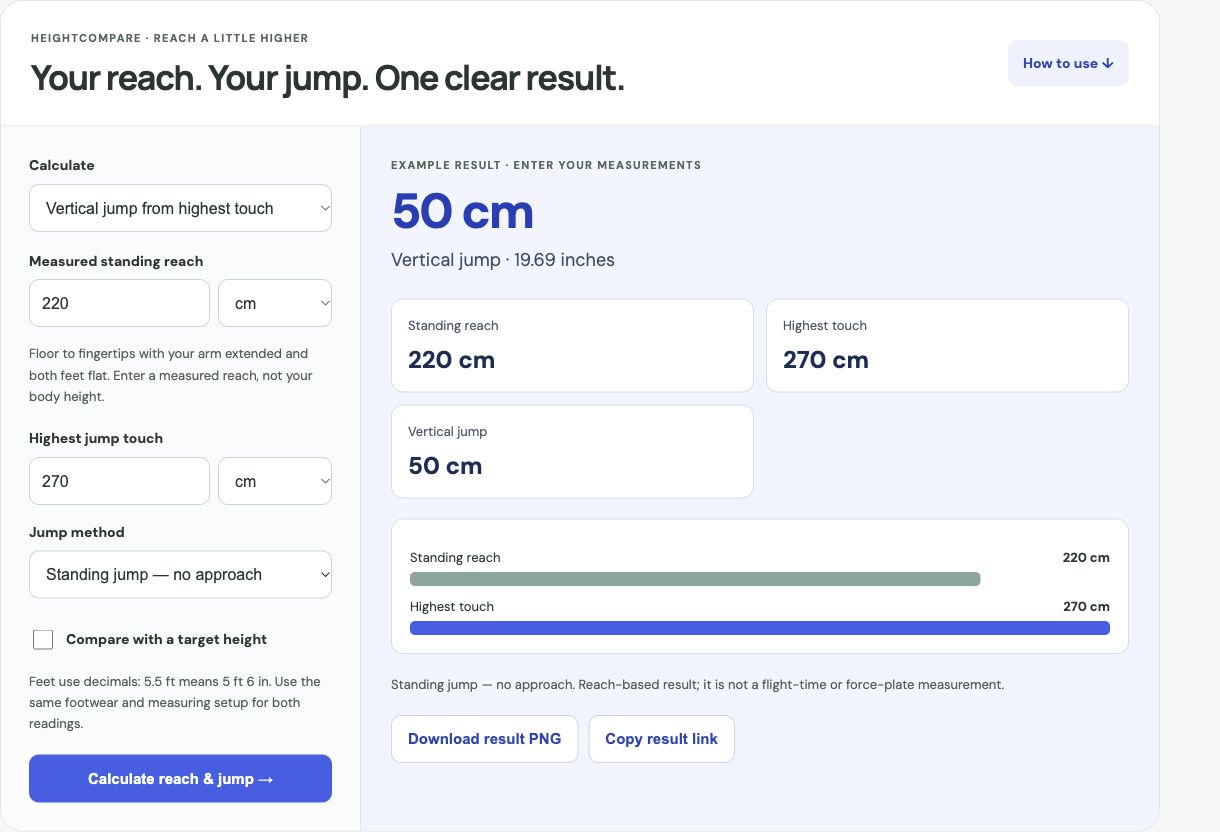
The reach calculator above uses an example of 220 cm standing reach and 270 cm highest jump touch. Replace both numbers with your measurements. The wingspan calculator further down compares arm span with barefoot height.
Standing reach, wingspan and height compared
| Measurement | Start and finish | Position |
|---|---|---|
| Standing height | Floor to top of head | Standing upright |
| Wingspan / arm span | One middle fingertip to the other | Arms extended horizontally |
| Standing reach | Floor to raised fingertips | One arm extended overhead; feet flat |
How to measure standing reach
- Use a level floor beside a vertical measuring surface, with enough space to extend your arm.
- Keep both feet flat and extend one arm overhead. Ask a helper to mark the highest fingertip position.
- Measure vertically from the floor to that mark. Record the arm used and whether you wore shoes.
- Repeat using the same position and measuring setup. If readings differ, check posture and the tape before recording a value.
When using reach to calculate a jump, measure the highest touch with the same footwear and setup. Record whether the jump was standing or used an approach. Changing the test method makes comparisons less useful.
How to measure wingspan
Extend both arms out to your sides at shoulder level. Keep your fingers extended and ask a helper to measure from one middle fingertip to the other, following a straight horizontal line. A wall can help you maintain a consistent position. Record wingspan separately from height and overhead reach.
Compare wingspan with your height
HEIGHTCOMPARE · MEASURE & COMPARE
How does your arm span compare?
Compare your measured arm span with your standing height.
How to use ↓For an illustrative height of 180 cm and wingspan of 188 cm, the difference is +8 cm and the ratio is 188 ÷ 180 ≈ 1.044. These describe the entered measurements; they do not establish standing reach or predict sporting ability.
Which measurement belongs in a vertical jump calculation?
Use standing reach. The reach-based formula is vertical jump = highest touch − standing reach. In the example screenshot, 270 − 220 = 50 cm. Subtracting wingspan instead would combine measurements taken in different directions and would not describe that test.
Keep your original readings alongside the calculated result. A jump-and-reach result is different from a result obtained with a flight-time device or force plate. More decimal places from unit conversion do not remove differences in measurement technique.
Frequently asked questions
Can I estimate standing reach from wingspan?
There is no universal conversion used by this tool. Measure reach directly; shoulder position, arm position and body proportions affect the relationship.
Is wingspan the same as arm length?
No. Wingspan runs across both outstretched arms and the body between them. A single arm-length measurement uses different endpoints.
Can I use feet and inches?
Yes. Select the appropriate unit for each value. For feet and inches together, entering total inches avoids decimal-feet confusion; 7 ft 4 in is 88 inches.
Further reference: the NBA combine measurements table lists wingspan and standing reach separately. For measurement history, use our height tracker; for unit notation, see decimal feet vs feet and inches.